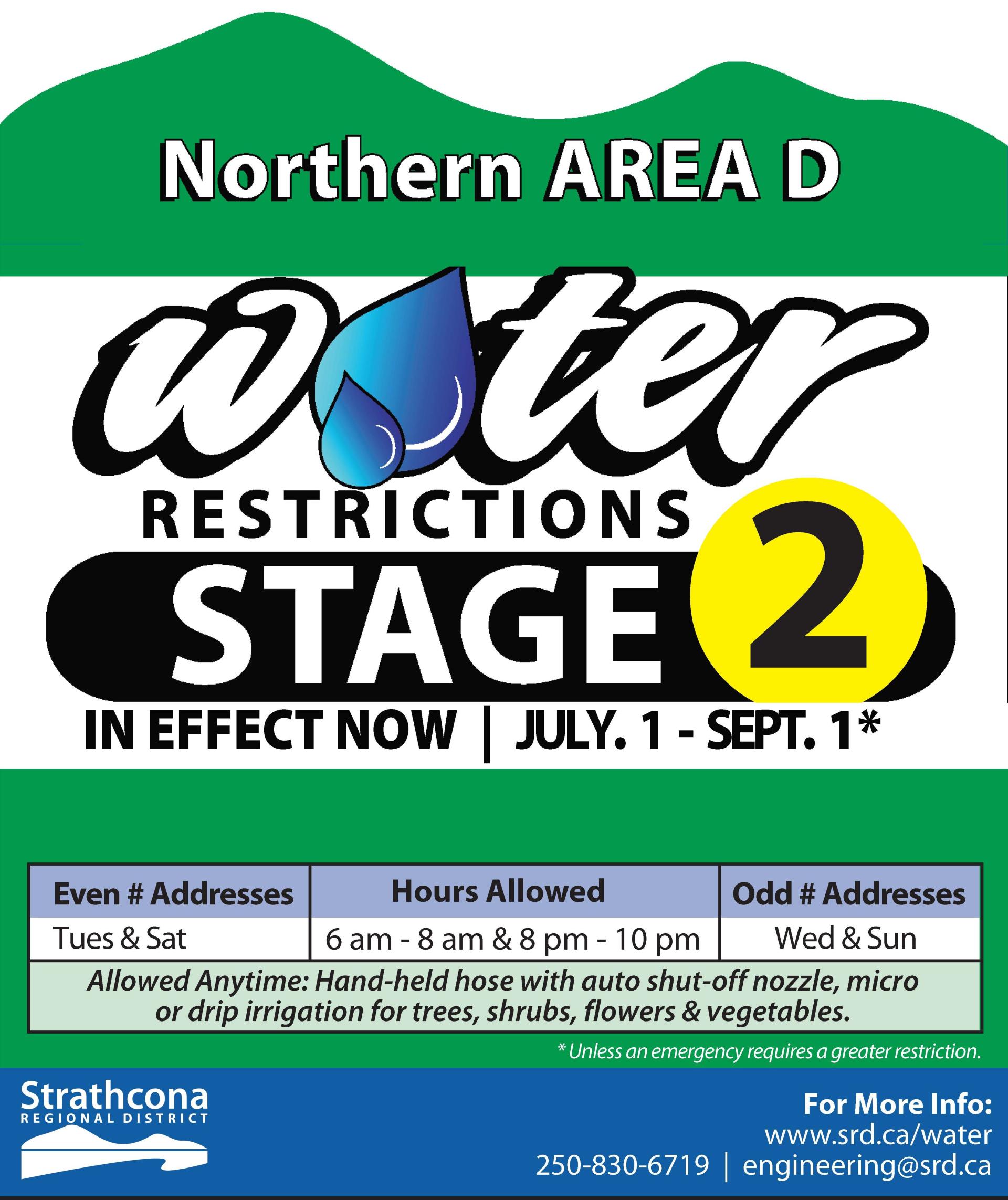
Area D - Stage 2 water restrictions in effect July 1 - Sept 1
Notice level: Low
Updated:
Sprinkler, soaker or weeper hose irrigation permitted from:
6 am to 8 am & 8 pm to 10 pm on:
💧Tuesday & Saturday for even numbered homes
💧Wednesday & Sunday for odd numbered houses
Refer to Bylaw No. 324 Appendix 'A' for all water restriction details
Image
About Bylaw
About 70 per cent of total water consumption happens outdoors in the summer, mostly due to sprinkler use on lawns. Sprinkler or soaker hose use on other landscaping can also contribute to the high summer demand. As such, the Electoral Area D Water Service Rates and Regulation Bylaw (#324) includes outdoor water use restrictions, to help reduce water use during the warmer months.
Three stages of water restrictions
Stage 1: Active from May 1 to June 30 and September 2 to October 1
Stage 2: Active from July 1 to September 1
Stage 3: Active when the SRD calls an emergency
Sprinkler, soaker or weeper hose irrigation permitted from 5 am to 8 am and 7 pm to 10 pm on:
Tuesday, Thursday and Saturday for even numbered homes
Wednesday, Friday and Sunday for odd numbered houses
Hand-held hose with automatic shut-off nozzle, micro or drip irrigation permitted at any time
The system must be installed correctly to avoid overwatering (or watering that saturates the lawn, boulevard or landscaped area, resulting in water spreading to areas beyond them)
Sprinkler, soaker or weeper hose irrigation permitted from 6 am to 8 am and 8 pm to 10 pm on:
Tuesday and Saturday for even numbered homes
Wednesday and Sunday for odd numbered houses
Hand-held hose with automatic shut-off nozzle, micro or drip irrigation permitted at any time
The system must be installed correctly to avoid overwatering (or watering that saturates the lawn, boulevard or landscaped area, resulting in water spreading to areas beyond them)
Sprinkler, soaker or weeper hose irrigation is not permitted at any time
Hand-held hose with automatic shut-off nozzle, micro or drip irrigation is allowed any day and for all addresses from:
6 am to 8 am
8 pm to 10 pm
The system must be installed correctly to avoid overwatering (or watering that saturates the lawn, boulevard or landscaped area, resulting in water spreading to areas beyond them)
Exceptions
In some situations, you may need to water your lawn or garden more frequently. There are exemptions during each stage of restrictions, but some exemptions may need you to get a Lawn Sprinkling Permit. Lawn Sprinkling Permits are valid during Stage 1 and 2 for:
21 days if watering sod
49 days if watering seed
During Stage 1, the following exemptions apply:
Watering newly planted trees, shrubs, flowers and vegetables by any method during installation and for the following 24 hours is allowed
Watering all-weather playing fields if failure to do so will result in permanent loss of plant material is allowed
Anyone who is unable to water their property within the restricted days and times due to a mental or physical incapacity that has been documented by a medical practitioner may water their property every second day for a maximum of four hours
Nurseries, farms, turf farms or tree farms with meters are exempt from the restrictions
Local governments are exempt from the restrictions
If you get a Lawn Sprinkling Permit, you may water new sod and seeded lawns at any time if done with a hand-held hose with automatic shut-off nozzle, or with a sprinkler from:
5 am to 8 am
7 pm to 10 pm
During Stage 2, the following exemptions apply:
Watering newly planted trees, shrubs, flowers and vegetables by any method during installation and for the following 24 hours is allowed
Watering all-weather playing fields if failure to do so will result in permanent loss of plant material is allowed
Anyone who is unable to water their property within the restricted days and times due to a mental or physical incapacity that has been documented by a medical practitioner may water their property every second day for a maximum of four hours
Nurseries, farms, turf farms or tree farms with meters are exempt from the restrictions
If you get a Lawn Sprinkling Permit, you may water new sod and seeded lawns at any time if done with a hand-held hose with automatic shut-off nozzle, or with a sprinkler from:
6 am to 8 am
8 pm to 10 pm
During Stage 3, the following exemptions apply:
Watering newly planted trees, shrubs, flowers and vegetables by any method during installation and for the following 24 hours is allowed
Watering all-weather playing fields if failure to do so will result in permanent loss of plant material is allowed
Note: Pressure washers are not covered by Bylaw 324, as they use far less water than a hose.
For outdoor water uses that are not related to watering lawns and gardens, the following restrictions apply:
Stage 1 and 2: allowed with a hand-held container or hand-held hose equipped with an automatic shut-off nozzle and at car dealerships or commercial car washes
Stage 3: allowed only at commercial dealerships or car washes using less than 205 litres per vehicle or that use 50 per cent recirculated water
Stage 1 and 2: allowed with a hand-held container or hand-held hose equipped with an automatic shut-off nozzle
Stage 3: allowed only if you are:
Applying a product such as paint, preservative or stucco
Preparing a surface for paving or repointing bricks
Required by law to comply with health and safety regulations
Stage 1 and 2: allowed.
Stage 3: Filling wading pools of 200 cm diameter or less, and up to 30 cm high is allowed. No filling or adding water to any:
Pools larger than 200 cm diameter
Hot tubs
Garden ponds
Stage 1 and 2: allowed
Stage 3: no filling or operating
Water Conservation
Making an effort to conserve water indoors and outdoors, year-round can help reduce the strain on the water system.
Lawn Care Tips to Conserve Water
To conserve water while caring for your lawn, following these tips:
Raise your lawn mower to 2.5 – 3 inches. This reduces evaporation from the soil and stress to the grass.
Check your soil quality and depth. If you have less than 8 inches of loam:
Top dress your lawn with a quarter inch compost or loam in spring and fall
Leave grass clippings behind as mulch
Adjust your sprinklers to a cycle and soak method (e.g. 5 – 10 minutes on/off/on/off etc.)
Add no more than 1 inch of water per week including rain.
Use a can (e.g. tuna) to measure how much your sprinkler delivers per 10 minutes and adjust watering accordingly. Grass cannot absorb more water than that.
Consider investing in a smart controller that can be set from your cell phone.
Switch your older timer for a newer model than can adapt to the new water restrictions.
Use these key techniques for keeping lawns green and healthy on little or no water:
Add lime in spring (and/or fall). Rainfall increases soil acidity and grass thrives in a near neutral environment.
Aerate your lawn in spring to reduce compaction and improve water penetration.
De-thatch if thatch layer is thicker than half an inch. A thin layer of thatch is beneficial for your lawn.
Install lawns in the spring or fall, rather than in the heat of summer.
Consider “going gold” by not watering your lawn over summer. If you raise your lawn mower, amend your soil, lime and aerate, your lawn will stay green longer, even without watering.
Install, schedule and maintain irrigation systems.
Consult an Irrigation Industry Association of BC (IIABC) certified irrigation professional for up-to-date advice on installing, scheduling and maintaining water-wise irrigation systems.
An irrigation professional can help you with:
Choosing the best system for lawns vs. beds (sprinkler system or micro/drip irrigation)
Selecting a timer that works on watering restrictions and can be programmed via your cellphone
Advice on irrigation scheduling
Information on smart controllers that adjust watering to account for rain
Proper yearly and monthly maintenance of irrigation systems
The IIABC lists certified irrigation designers, installers and schedulers on their website. To do the search yourself, in the drop-down boxes select:
All types
Vancouver Island/Coast
All Classifications
To hire a contractor or for getting advice on irrigation scheduling, here are some recommendations from the IIABC. The last four points are most relevant when considering a new irrigation timer. These questions should be asked before a contractor submits a proposal on your landscaping, to protect yourself and your investment:
Do you have a business license, and will you show it to me?
How many years has this specific company name been in business and can you supply reliable references?
Does your company carry liability insurance and if so, to what extent?
What type of cross connection control or backflow prevention is required by our municipality? Does your company have a certified cross-connection (backflow) expert on staff?
Is your company a member of the Irrigation Industry Association of B.C.? (You can search for Certified Professionals on the IIABC’s website to verify this.)
If I select your design, are you able to stamp your design with an approved IIABC Certified Irrigation Designer stamp or have an approved designer certify it?
What types of products will you use and why?
Is the contractor able to provide irrigation scheduling information using Farmwest and /or the IIABC scheduling calculator?
Has the contractor provided a schedule to match peak conditions and provided information on how to adjust the schedule?
Will the irrigation system be able to provide sufficient water to the plants within the local government watering restrictions?
In the spring:
Reset timers, ensure they work
Adjust for new bylaw sprinkling restrictions
Add a rain sensor or smart controller
Set irrigation schedule according to established monthly evaporation for this area to avoid wasting water in spring and fall
Check for blocked or misaligned sprinkler heads
Check for leaks
Test backflow prevention valves and check valves
Turn your system on monthly to check for:
Wet/dry patches indicating plugged nozzles
Arc that is watering roads or driveways
Don’t forget to turn system off in the fall and blow your lines out.
Other Water Conservation Tips
Below is advice on reducing water consumption, especially if summers continue to get hotter and drier.
If properly installed and scheduled, micro-, or drip irrigation systems will irrigate garden beds, shrubs and trees using much less water than a traditional above ground or automatic sprinkler systems. Consult IIABC certified professionals to ensure the installation is done correctly.
Mulch is key to water conservation
Non-organic mulching materials can be used, but to improve the depth and health of soil, organic material is best. Organic mulching includes:
Chipped hard wood (preferred, as breaks down faster) or soft wood trees using the whole tree (except cedar)
Given the predictions for longer, drier summers, consideration should be given to landscaping with native or drought resistant plants.
Consider using trees, shrubs, flowers that are adapted to the conditions of the region: Warm, dry summers and wet, cool winters.
Contact knowledgeable staff at local garden stores or the SRD at 250-830-6718 or engineering@srd.ca for information on resources available.
Wash vehicles, boats, windows, buildings and driveways using a hand-held hose with automatic shut off nozzle.
Sweep driveways instead of rinsing and rinse just to keep dust down.
Use a pressure washer instead of a hose: pressure washers use 50 to 80 per cent less water than a garden hose.
Fill pools or hot tubs to within 15 – 20 cm from the top. Cover when not in use.
Indoor Water Conservation
About 30 per cent of water use happens in the home. Some steps to reduce water consumption in the home include:
Install low flow toilets
Install low flow shower heads
Select water-efficient washing machines and dishwashers
Install aerators on taps
Wash only full loads
In summer, fill a jug and keep in fridge rather than running the tap to get cold water for each glass
If running the tap to get cold water, consider catching that water for indoor or outdoor plant irrigation
Water Conservation During the Fall and Winter
Follow these five tips to help reduce your water use during the fall and winter.
Detaching a hose allows water to drain from the faucet. Otherwise, a single, hard overnight freeze can burst either the faucet or the pipe it is connected to.
Be sure to isolate your irrigation system and have the lines “blown out” with air. As temperatures change, stagnant water left in irrigation lines contracts and expands leading to cracks and breaks in the pipes. Often these lead to leaks which go undetected for months until the irrigation system is put back online for the summer. Be sure to check for leaks when restarting the irrigation system in the spring.
Save water by protecting pipes. Get a professional plumber to wrap exposed or vulnerable pipes (or add insulation) so that they stay warmer and are less likely to leak or burst.
When most people turn on their shower, they let the cold water that comes out of it for the first few seconds run down the drain. Instead of letting all that water go to waste, consider using a bucket to capture it and then using that water for household tasks like cleaning, flushing toilets, or watering house plants. Best of all, you can use this trick all year round.
In the event of a leaking or burst pipe, immediately shut off the water to your home or building. This will save money on water and property damage repairs. The quicker you can turn off that water, the less goes to waste (and harms your structure and/or valuables).